


Greenland of Plenty (Trek and Mountain Issue 124)
- Sean William Mackey
- Oct 25, 2025
- 8 min read
Published Trek and Mountain Winter 2024
I always imagined Greenland to be one of those far-flung places that only serious adventurers who enjoy suffering and have amazing beards would go. However, I have recently returned from a British Army trip to the East Coast of that vast country and been pleasantly surprised by the weather, ease of access and variety of activities for climbers and trekkers of all levels.
Getting to Greenland from the UK was pretty quick and painless. Flights into Iceland leave from most major UK airports and the connecting flight from Reykjavik to Kulusuk depart each day during the summer months. From leaving the UK at 1pm we landed at our final destination at 7pm local time. They’re only 2 hours behind GMT so we didn’t even encounter any jet lag.

Planning trips are always times of excitement with dreams and objectives slowly becoming realities. I wanted to take as many soldiers from my unit (The Light Dragoons) as I could. I split the trip in half and had two separate eight person teams come out on one after the other. The instructors remained in Greenland throughout and became more in step with the mountains as each day passed.
This allowed me to make the most of the region and head to two different venues and keep the military guides fresh and engaged. All of this movement was aided by Pirhuk Greenland Guides who are the local logistics and guiding company on the east coast of Greenland. They’re the best (and also the only) guiding company with the team made up of British Mountain Guides and International Mountain Leaders of some renown. Their experience was second to none and they certainly knew the area and where to get the best out of the teams and the weather.
After picking up some local shopping and rations for the duration. We took an initial boat journey out with team one to the island of Apusiaajik about 40mins north of the main airport on Kulusuk. The excitement of starting the trip with a speed boat ride was only topped when three Whales began playing in the bay of our Island and prevented us going ashore. There are worse 60min delays than being forced to sit and watch up close one of the largest mammals on earth playing and breaching the surface.


These are obviously not the only mammals in the region and one that was at the forefront of our minds was the Polar Bear threat. Although it is rare to see them in this region over the summer months the late breakup of the pack ice saw many reports from local hunters and fishermen of Polar Bears in the area. This apex predator is naturally curious and will take calculated chances in the hope of getting a meal. Gradually building up confidence with larger groups until they decide to attack. We certainly didn’t want to be part of their food chain and carried high calibre hunting rifles to use as a last resort if the other measures didn’t scare it away.
Once we had disembarked the boats the laborious task of setting up the base camp began. Much of the island is Arctic tundra or thickly covered in lose scree from the moraine. The beach proved to be the best place to set up camp with our sleeping tents, latrines and mess tents all being equally spaced 75m apart in a triangular fashion to try and spread our scent. A polar bears sense of smell is 2,100 time better than a human! This also meant we didn’t have to lug all the gear further inland to a worse camp site.
The mapping to the region is fairly limited and hard to get hold of in the UK. The 1;100,000 proved the most useful and showed the extent of the glacier system, but with scant other detail. Google earth and Garmin’s mapping where more useful on the ground and help place features on the sketchy mapping. The first day after arriving we made the journey on the glacier and conducted an Ecole de Glace for the novices in the group. Introducing some of the Alpine travel techniques they required for the rest of their time. This also gave us instructors a time to take stock and come up with some good objectives for the next few days. The glacier system was fairly benign, but extensive with branches shooting off in all directions. We fondly called it Piccadilly Circus and it became a bit of a starting point for the future excursions to explore the mountains.

The trip was expeditionary by nature as along with no mapping there is also no guidebook. Much of the information was gleaned from BMGs Matt Spenceley and Martin Chester who gave their knowledge quite freely. Binoculars and a spotting monocle were great assets and made route finding significantly easier, but it still felt like you were venturing into the unknown.
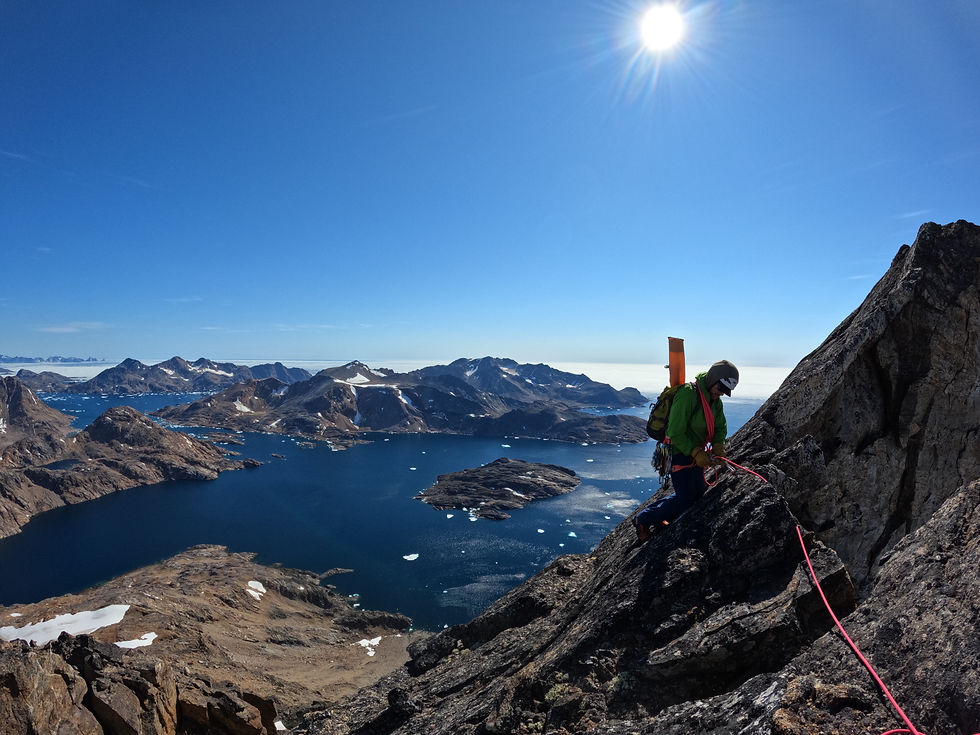
The first mountain attempted was Nanoq Qaqartiva (721m) at the very centre of Piccadilly Circus. Don’t let the height fool you this journey was over glacial terrain with exposed and steep snow slopes culminating in a sublime snow arete to the summit. One of the other groups made an ascent of neighbouring ‘Long Ridge’ (614m) which was mostly on a steep sided narrow rock ridge to a beautiful pointy summit. Neither were overly technical with both being around PD in their grade, but were part of a delightful mountaineering journey in perfect weather.

The most technically satisfying mountain has to be Inutugai (557m) or as we called it Finger Ridge. The very top is marked by a large pillar of rock standing proud from the rest of the ridge. This striking feature can be seen from miles around and the Greenlandic translation of Inutugai is standing man. With surprisingly solid and sound rock the journey to the summit had some pleasing rock corners and slabs which kept going all the way to the top. The 8m high ‘finger’ at the summit has been climbed before and looks straight forward, however, it would take a braver climber than I to ascend the thin teetering tower.

The biggest mountain on Apusiaajik is High Peak standing 826m above the iceberg choaked sea. The ascent of this was certainly a highlight and is a must for anyone visiting the island. 360-degree views out to the Arctic Ocean and further inland onto the ice cap were awe inspiring. The mountain itself is straightforward to climb and again had a charming snow arete guiding you to the summit.
Most of Apusiaajik has been explored, but some of the steeper rock faces had yet to be climbed. The team managed to climb four new routes on an enchanting and clean rock face only 200m from the base camp site. Sitting at an impressive 150m tall if it had been in the UK it would certain have been a classic venue for trad climbers. Venturing up the route was uncomplicated with only some well protected 4a moves to contend with. Joe Robertson having not found a name for it christened it ‘Dragoon Crag’, but will gladly rename if we can source the local label for it.
Changing over from the first team halfway through the trip to the second was pretty fraught. A winter storm rolled in and flights to and from Kulusuk were delayed for three days. The warm and cosy lodge lovingly managed by Helen and Matt from Pirhuk was a safe refuge and the days were wiled away playing Bananagrams and cards. When the storm calmed for 24hrs we swiftly changed the teams over on the flights and made further plans. This fine weather window was short lived and a further bigger storm was expected 12hours later.
The Greenlandic weather is quite steady over the summer months. With being such a big land mass an area of high pressure often sits over the ice cap and creates a nice stable weather system with long days of sunshine and fine conditions. It is certainly worth remembering that you’re in an Arctic environment and that the temperature range is vast. We experienced baking days on the glacier stripped down to base layers through to freezing temperatures in big down jackets. The 24hours of daylight takes some getting used to and quite a lot of discipline not to stay up later than expected. Sleeping in eye masks and having a set bed time makes resting and recovery better.

With such a fierce coastal weather onslaught expected we took some advice and travelled further in land and to the end of a Fjord near Tillerlaaq in the hope of avoiding the worst of it. This is a 1hr 20min boat journey and sped by some magnificent peaks that haven’t been climbed, but would be much harder technical objectives.
When the storm hit the rain and winds lasted solidly for 48hrs and we had little option but to hunker down in our tents and wait for the weather to clear up. While it isn’t the glamourous side of mountaineering it is often these moments that leave the best memories- Just enduring something stoically with your friends. Endless brews, jokes and conversations can often be just as valuable as the activity itself.
The northern most glacier from this new basecamp location gave access to numerous mountains and ridges all between 1000m and 1300m.

After the storm broke, we made our way through the moraine and a rather chilly river crossing to the glacier. This 6km walk in was then compounded with a further 5km slog up through the glacier to our objective at the very back of the corrie. Three teams made the trip onto the glacier and all were rewarded with what we believe are first ascents. Adie Williams and I each took a team and went for the highest in the massif. Adie made the torturous thigh burning schlep up the back of the mountain while I took my team up a slightly less painful rock rib. The work for both teams was worth the view- as it always seems is the case in Greenland. The lactic acid build up in the thighs was obviously worth it as Adie did make the summit before me though!
The third team led by Huw Gilbert did what was considered as the best route of the whole trip and on a smaller mountain to the east of the glacier. This climbing was clean and obvious with the added value of finishing on a ridge leading to the true summit. Probably technically harder this PD+/AD- route was well worth the struggle through the initial moraine scree slopes. Huw’s understated comment over the radio before tackling the climb was- “I might as well have a go”.
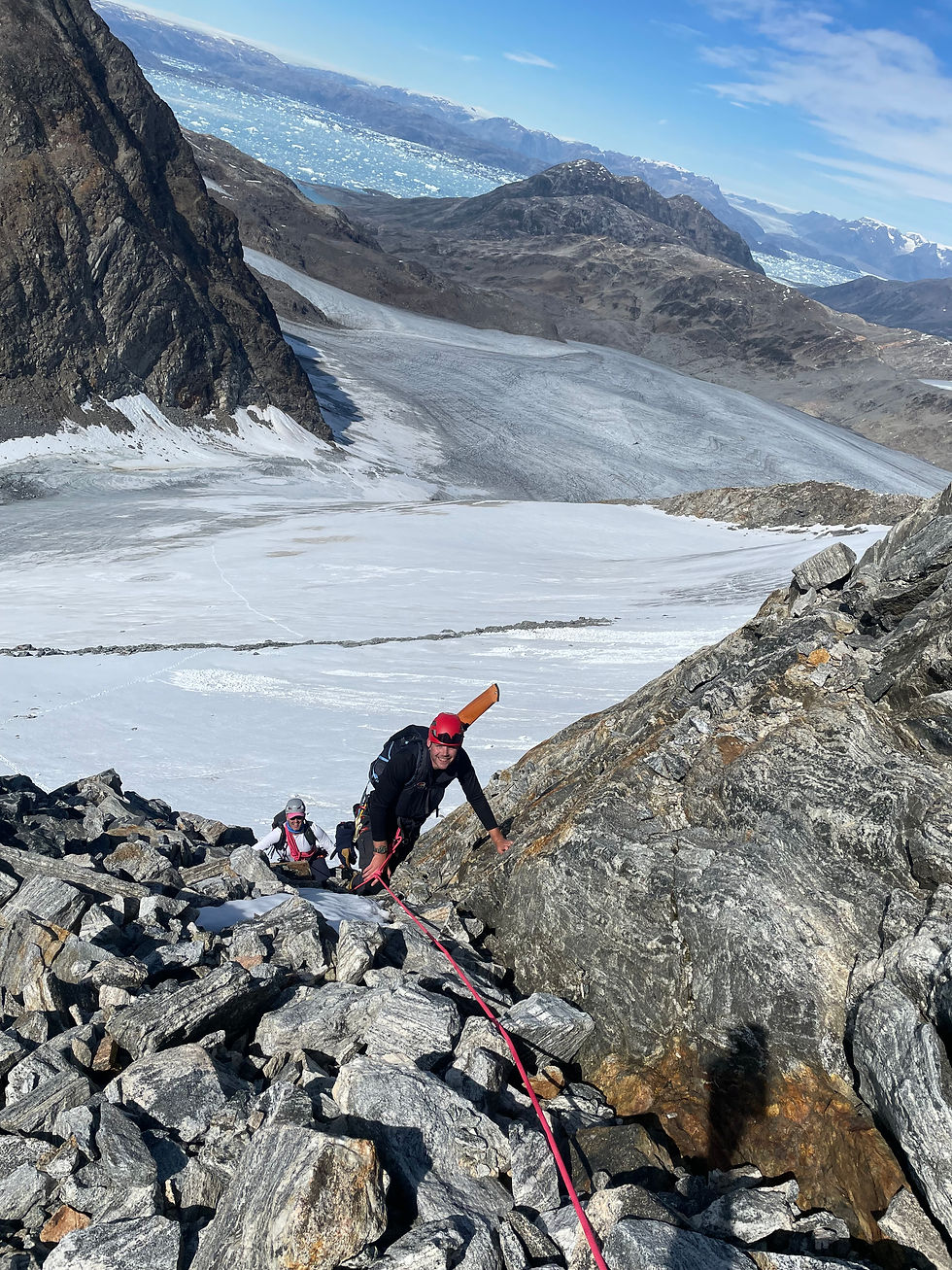
Neither of the mountains or ridges are named and I believe none of them climbed adding to the first ascents made by the previous team.
Returning by boat to Kulusuk was difficult with the amount of ice that the winds had pushed into the natural harbour and bay. Watching the local boat handlers, fishermen and sailors expertly picking their way through these obstacles was impressive to witness. Powering the boats to push the floating icebergs out of the way really showed the issues the locals have even in the middle of summer.
Flying back from Greenland was equally as painless as flying out, but with a slightly longer wait between flights in Reykjavik. The trouble-free flight home was only compounded when Icelandic Air misplaced our luggage on the return journey.

As a venue Greenland is hard to beat. The mountains are smaller in height but still have the challenges and grandiose of the Alps along with being seriously easy to get to. The cost is pretty reasonable too when compared with trying to pay for transport and accommodation in France or Switzerland. The aspect I particularly liked was the unexplored nature of the trip- Having poor maps and no guidebooks made the trip exciting and spontaneous. Taking advantage of the situation rather than just having set objectives was refreshing. If you have an adventure and exploratory itch to scratch alongside your climbing one, make your way to Greenland and enjoy the unknown.
The British Army is an advocate of Adventurous Training and encourages all its members to complete skills and qualification courses and to go on expeditions around the world in your chosen discipline (Mountaineering, paragliding, kayaking etc).
Major Sean Mackey RDG is a military Alpine Mountain Leader, Winter Climbing Instructor and Winter Mountain Leader. He is a Fellow of the Royal Geographical Society also a member of the Association of Mountaineering Instructors. He has led Adventurous Training teams all over the world from Northern Norway, Africa, the USA, Europe and Nepal to name a few. He currently splits his time (not very evenly) between commanding a reconnaissance Squadron and living with his family in the Lake District.


Comments