


48 hours in the Carpathian Mountains (Trek and Mountain Issue 126)
- Sean William Mackey
- Oct 25, 2025
- 8 min read
Published Summer 2025.
The Carpathian Mountains are nestled in the heart of Romania and are both a land of opportunity for a climber and mountaineer as they are an enigma. The horseshoe shaped mountain range is dramatically set against the flat lands of Transylvania and the numerous Saxony fortified towns perched on crags and hill tops. Romania is home to some grandiose mountains with the biggest being Moldoveanu Peak and stands and impressive 2545m tall.

Romania also benefits from having distinct seasons with summer and winter activities making it a climber’s playground all year round. However, finding details, guidebooks, route descriptions or indeed maps can be quite a challenge. Most of the website are in Romanian and require a level of google translate competence that I simply don’t possess. The Alpine Club of Romania (ACR) have some hand drawn topos and maps to the most popular area, but again the handwritten notes on these require translating.
Flying out to Bucharest is surprisingly reasonable with numerous of the cheaper airlines offering a regularly drumbeat of flights to this Black Sea state. Bucharest itself is situated on the flat plains and has little relief or even an incline to ascend. It’s a mixture of old Soviet concrete buildings, modern architecture, and some very old and characterful gems. Unfortunately, a town planner has not been involved and often these sit next door and in juxtaposition of each other. The suburbs felt a bit run down and tired with the centre of the city being reserved for the wealth and mega-rich. Of note when moving around the city is that Bucharest also boasts the worst driving accident statistics of the EU. Moving out of a junction requires a little aggression and plenty of nerve. The liberal use of the car horn while commuting is not optional! Taking out a solid insurance policy for the hire car is a must.
I had been invited out by a friend who had been working there for just over a year and had managed to suss out some objectives. His contacts in the ACR and having made some friends in the climbing community was key to the weekend. Even with this insider knowledge it still felt quite exploratory and exciting.
Sadly, with a fulltime job, career and family I am a slave to my diary. If I want to go away it isn’t spare of the moment opportunities, but more likely to have been planned months ahead to make sure work and home life were covered. Therefore, I only had a long weekend allowing 48hours to explore the mountains. Conditions hadn’t synced with my diary though, and we were left scrabbling about for the best adventures we could find. I must hand it my good friend Neil who was looking after me, he corralled all the information he could to find some exciting options.
Romanian weather suffers as Scotland has this past winter. Large dumping of snow and freezing temperatures have been followed by highs of 18°C. This resulted in the stripping of snow and ice from only the most sheltered gullies or North Faces. Rather worryingly much of the snow can’t been seen from the roadside with the mountains looking black and clean from lower levels. It paid off making an effort and walking up to the crag where it became much more obvious.
The town of Busteni is dwarfed by some imposing slopes, crags and gullies rising almost vertical from the towns 925m elevation to over 2400m in less than a kilometre. On the most prominent cliff sits the Crucea Eroilor Neamului at 2300m. Loosely translated this means ‘Cross of the Heroes on Mount Caraiman’. It is dedicated to all the Romanians (military and civilian) who gave their lives in the First World War. When illuminated at night and at distance it gives the impression of being a mere 6m high monument, when in-fact it sits at over 40m tall in addition to the two-storey building acting as its base.

The cliff below the cross has a deep gully, which on its north wall has over a dozen mixed winter routes with some over 1000m in length. The south wall catches more day light and is cleaner for summer rock routes and scrambles. While the rock is clean there are large swaths of conglomerate which would require a steady head for trad leading. The bolted sport routes looked much more amenable and were generally on the cleaner and more solid looking granite slabs.
After parking in a residential street in Busteni we began making our way up to the cliff. Walking in was steep, winding and sweaty with the paths seemingly being rarely trodden. The European convention of marking trees every 20m with coloured paint guided our way to the rock face. Both Neil and I had recently come back from Greenland and were used to being on bear watch. Although it is unlikely to see Brown Bears approaching people, they have been known to attack people when surprised or desperate for food in particularly lean months (like winter!). We kept our eyes open and made plenty of noise to make sure we were not part of the x26 deaths or x274 people injured by Brown Bear in Romania in the last 20 years.
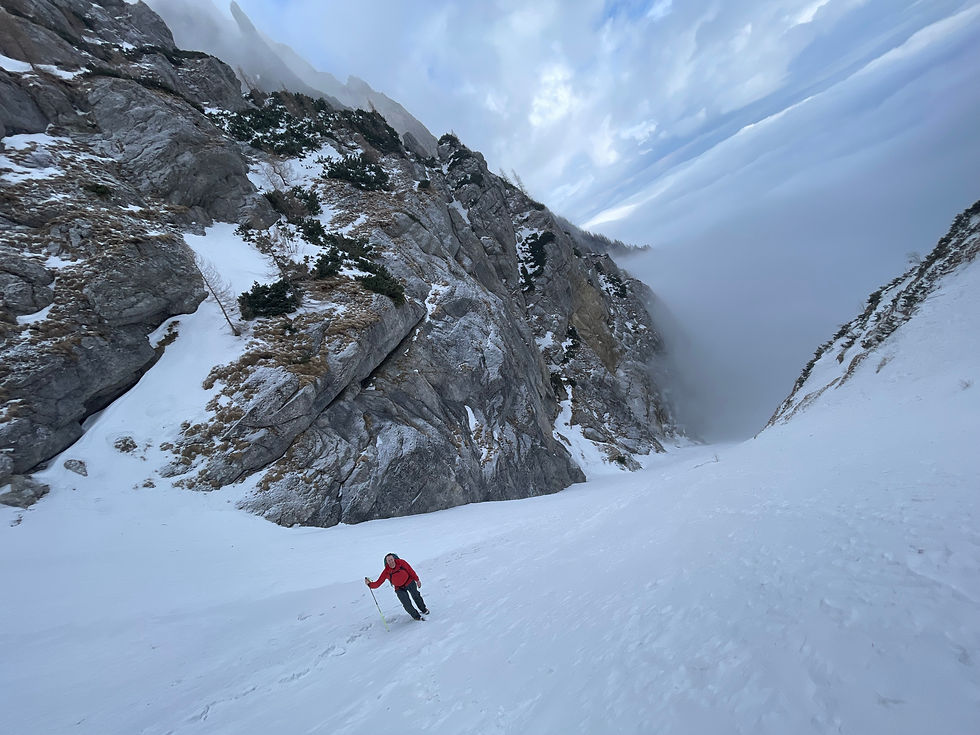
The loose plan was to walk in and see what was in condition to climb. The plum classic line is Albisoara Crucii (Russian 2a) that leads straight up to the highest point on the ridge and was my preference, while Neil hoping for Albasoara Hornuritor (Russian 2a) to be viable too. As always, the best plans never come to anything and only one route was in ‘nick’. The long route of Valea Alba is at the bottom of the deep gully (Russian 1b) and became the main objective having held a good layer of snow. The snow was littered with some rocks that had obviously come down in the unseasonable warm week before I flew out. I didn’t see any fall while I made my way up the route, but I can see how the freeze/thaw would attack the conglomerate and create these falling hazards.
The gully leads up to Saua Vai Albe (2405m) in a continuous schlep of epic proportions. I would liken it to Tower Gully on Ben Nevis or Raeburns Gully on Creag Meagaidh. With broad and narrow passages giving some interest to the journey but being much longer at 800m in length. Arriving at 2100m with burning thighs and breathing heavier than ought to, we broke off and took a traverse line recommended by the ACR website.
This airy rising traverse line went on for 1km over the top sections of this large face. Simple enough (maybe Scottish I/II) it provided some welcome relief and interest to the journey up. The weather had also settled and blessed us with a cloud inversion and bright sunshine. While the climbing was not challenging the exposure and consequences of a fall focussed the movement with good crampon skills being a must. The Crucea Eroilor Neamului sits at the end of this traverse and became the reward at the end of the climb. The local populations loss at the end of WW1 must have been great to honour their soldiers and war dead in such an enormous way.
The walk over to the cable car for the journey down was simple from here and well signposted from the top. The snow on the plateau had survived well and we were surprised to see drifts and snow holes of 2-3m. In white out conditions the plateau could be challenging for navigation. Memories of being stressed on my Winter Mountain Leader Assessment on the Cairngorm plateau came to mind.
Once back down to Busteni we stopped for a coffee and a look at every weather app going we were on the hunt for better conditions for the following day. Then made the choice and drove four hours that evening to Balea Lake in the Făgăraș Mountains. Being frugal we slept by the van. I would not recommend bivvying on the wooded roadside due to the abundance of stray/guard dogs who are notoriously aggressive along with the bear threat…
The Tranfăgăraș Highway winds its way over the mountains and is notorious for motorists as it has endless chicanes and switchbacks. In 2010 Top Gear made an episode where Jeremey Clarkson drove it and described it as ‘The most amazing road I have ever seen’. In winter the road is impassible, but a cable car uplift deposits you at 2034m with Alpine peaks and snow in abundance. The top is often closed due to wind and heavy snow with the summit sitting above a cauldron (what the Romanians would say for a Cwm or Corrie).

The uplift is extremely popular with queues forming an hour before the first cable car was due to leave. The reason is that it has a bit of fun for everyone. Ski touring, mountaineering and ice climbing are all possible here and within an easy 15min flat walk from the top cable car station. Families with young children sledged on the small slopes by the cable car station and then nipped into one of the two different cafes for an overpriced hot chocolate. There is even an ‘ice hotel’, which conjured up images of a James Bond villains lair, but it turned out to be nowhere near as glamourous!
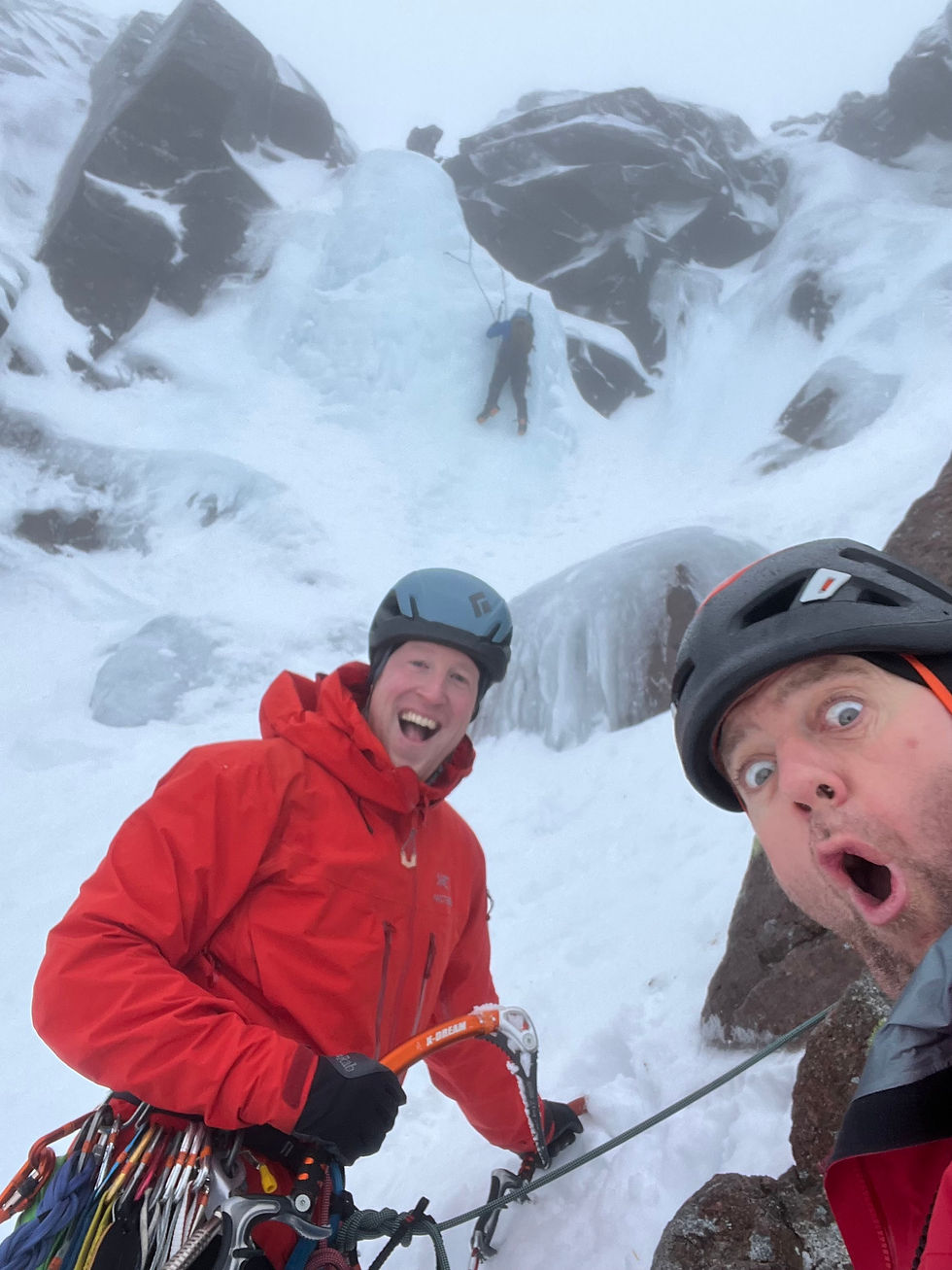
We went for the icefalls and were not disappointed. Located on the back wall were several single pitch routes upto WI4. The ice was thick, sound and every screw could have easily been a 22cm jumbo option. Reaching the top of the routes were good flattish areas that we could have walked the five minutes around from and back to the base. We chose to abseil down to be quickers and left a backed up abalakov thread to do as many routes as possible.
Again, with no guidebook or topos we had the delightful freedom to make it up as we went along. There were a few pieces of tat from old abalakovs that showed some of routes others had taken, but we only used them as loose guide. We managed five routes each on the largest of the ice falls and loved every second. There were two other smaller ice walls slightly higher on the ridge that we didn’t get the time to look at, but both would have probably yielded another four routes of 20m single pitch ice.
The locals walked across the frozen lake to visit the ice we were climbing on, which forms a small cave you can crawl into on one side. When we left to start walking back, we were not as brave (or cavalier) as them and walked the extra 10mins around the water’s edge to save any frightening moments of breaking through. The climbing was satisfying but with only really enough for a day trip before it being climbed out. The ridges forming the edge of the cauldron look very entertaining and provides a continuous traverse (Russian 3a), but we didn’t have time to sample it before having get the cable car down and to leave for the journey home. With the warm weather conditions this was much better snow and ice than we were expecting.
The four-hour journey back to Bucharest was passed by admiring the driving skills of the Romanian motorists and chatting about future expeds and trips.
Romania is easier and quicker to get to than you might think with just over three hours spent on the aeroplane. Although the majority of the country is very affordable in general there are certain things that are not. For example, the two cable cars (The first being down only) cost more than the return flights with extra baggage. A litre of diesel is £1.20 which is above the European average, but much cheaper than we had come to expect.
The Carpathians have an adventurous feel to it due to the lack of guidebooks and topos, but there is information out there which will give an idea of where to go. The language is not terribly mainstream, and a lot of the population don’t speak English. Romanian is more akin to a romantic Latin-based language only with a few heavy Slavic syllables more expected in Eastern Europe. I used Google Translate a lot to get by in shops and cafes and I’d recommend the same unless you really want to spend a long time on Duolingo beforehand!
Two days is never really enough to get into the climbing style of any venue, but the vibe was positive, and it just means I’ll just have to go back and sample more.


Comments